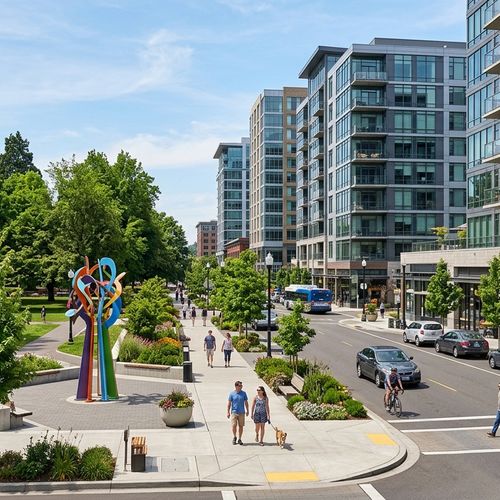



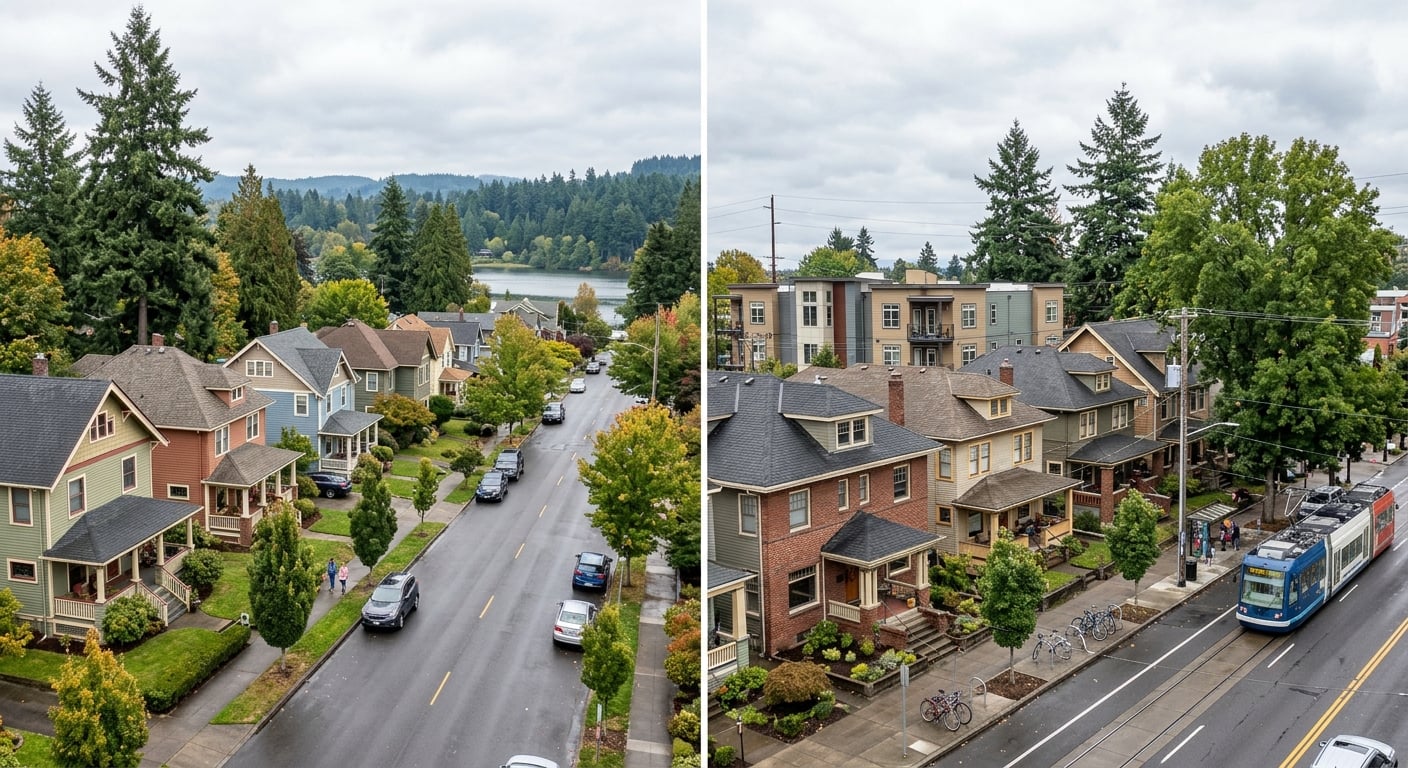
Camas and Portland are two of the cities I work in most often, and buyers weighing one against the other ask me the same handful of questions nearly every time. Here's a direct, side-by-side look at how the two actually compare, based on what I see with real listings and real buyers.
Executive Summary
Camas, Washington and Portland, Oregon sit on opposite sides of the Columbia River in the same metro area, but they're very different kinds of places to live: a small, established Clark County city compared to Oregon's largest city.
Camas is a single, compact city with one historic downtown and a population in the tens of thousands; Portland is a much larger city of roughly 635,000 residents, spanning dozens of distinct neighborhoods with very different character and price points.
Portland's housing stock and prices vary enormously by neighborhood, from inner-eastside craftsman homes to outer-area infill construction, while Camas's housing stock is comparatively uniform and concentrated.
As of recent Redfin data, Portland's citywide median sale price runs below Camas's, though that citywide figure masks significant neighborhood-to-neighborhood variation within Portland itself.
Camas at a Glance
A single, compact downtown along NE 4th Avenue, with local shops and restaurants, rather than Portland's many separate neighborhood commercial districts.
Lacamas Lake, the Lacamas Heritage Trail and Round Lake Park, all within a short drive of most Camas addresses.
One public school district, Camas School District, instead of Portland's patchwork of districts and periodic boundary changes.
Direct access to SR-14 and I-205, with a shorter, more predictable commute into Vancouver and east Portland for many Camas addresses.
Camas School District, ranked 15th of 238 Washington school districts by SchoolDigger as of 2026 (with 8 five-star-rated schools), a real, often-cited factor in why buyers specifically target Camas.
Camas Price Points & Amenities
Median sale price: $800,000 over the trailing six months (428 closed sales), per Resideline's Camas market report (ZIP 98607) as of October 5, 2026; the middle half of sales closed between $595,000 and $965,000.
Housing stock: a mix of established single-family neighborhoods, newer subdivisions and some ongoing new construction, spanning several decades of development.
Camas community page: https://jamiemeushawrealestate.com/communities/camas/
Check out this neighborhood in Camas (Deer Creek): https://jamiemeushawrealestate.com/moving-to-camas-wa-consider-deer-creek-wooded-lots-quiet-streets-on-prune-hill/
Watch: Living in Camas, WA (YouTube playlist): https://www.youtube.com/playlist?list=PLEh0DURDVECF3CgeNR6_omDk70sG7Dzzh
Portland at a Glance
A far larger selection of neighborhoods and housing types, from inner-eastside craftsman and foursquare homes to newer infill and multifamily construction throughout the city.
Forest Park, more than 5,100 acres and among the largest forested urban parks in the country, along with Washington Park's Japanese Garden and International Rose Test Garden.
A dense network of interstates (I-5, I-84, I-205) and TriMet's bus and MAX light rail system, offering more transit options than a smaller city like Camas.
Multiple school districts depending on address: Portland Public Schools covers much of the city, but David Douglas, Parkrose and other districts also serve parts of Portland.
Portland Price Points & Amenities
Median sale price: $518,000 over the three months ending September 2026, down 2.2% year over year, per Redfin's Portland housing market page.
That citywide figure covers a wide range: individual Portland neighborhoods can run well above or below it, so a citywide median is a starting point, not a substitute for checking a specific area.
Housing stock: broad and varied, from early-1900s craftsman and foursquare homes in inner neighborhoods to mid-century homes and newer construction throughout the rest of the city.
Portland community page: https://jamiemeushawrealestate.com/communities/portland/
Check out this neighborhood in Portland (Irvington): https://jamiemeushawrealestate.com/moving-to-portland-or-consider-irvington-demand-for-a-real-historic-district-doesnt-slow-down/
Watch: Living in Portland, OR (YouTube playlist): https://www.youtube.com/playlist?list=PLEh0DURDVECEbBfnaW5QcuZR0O9dXpOBB
Comparing Camas and Portland
Camas, Washington and Portland, Oregon are both part of the same Portland-Vancouver metro area, separated by the Columbia River, but comparing them means comparing two fundamentally different kinds of places: a small, single-downtown city against Oregon's largest city. Buyers who ask about both are usually weighing a smaller, more predictable city against the scale, variety and amenities of a major metro core.
Camas is compact. One historic downtown along NE 4th Avenue, one public school district, and a population in the tens of thousands concentrated in a single city with a handful of named neighborhoods and subdivisions. Its housing stock, while varied in age, is still relatively uniform in character compared to a much larger city: mostly single-family homes across established and newer subdivisions, without the full range of housing types found in a major urban core.
Portland is a different scale of place entirely. With roughly 635,000 residents, per U.S. Census Bureau estimates, it's by far the largest city in the metro area, made up of dozens of distinct, differently named neighborhoods, from dense inner-eastside areas with early-1900s craftsman and foursquare homes, to outer neighborhoods with newer infill and multifamily construction. That range means housing stock, price and neighborhood character vary far more within Portland itself than they do across an entire city the size of Camas.
Price is where the comparison gets genuinely complicated. As of October 2026, Camas carried a median sale price of $800,000 over the trailing six months, per Resideline's Camas market data (ZIP 98607). Portland's citywide median sale price, by contrast, was $518,000 over the three months ending September 2026, down 2.2% year over year, per Redfin's Portland housing market page, lower than Camas on a citywide basis. But a single citywide figure for Portland hides enormous neighborhood-to-neighborhood variation: some Portland neighborhoods run well above Camas's price level, others run well below it. A citywide median is a reasonable starting point for Portland, but it's not a substitute for checking the specific neighborhood a buyer actually has in mind.
Parks and outdoor access look different because of the difference in scale. Camas residents have walkable or short-drive access to Lacamas Lake, the Lacamas Heritage Trail and Round Lake Park. Portland has Forest Park, more than 5,100 acres and among the largest forested urban parks in the country, along with Washington Park's Japanese Garden and International Rose Test Garden, plus dozens of smaller neighborhood parks scattered throughout the city. Portland offers more total park acreage and variety; Camas offers more concentrated, easy-to-reach access within a smaller area.
Commute and transit options also reflect the difference in scale. Camas connects to the rest of the metro primarily via SR-14 and I-205, with a relatively short, predictable route into Vancouver and east Portland for many addresses. Portland sits at the center of the region's interstate network (I-5, I-84 and I-205 all run through or around the city), and is served by TriMet's bus network and MAX light rail, giving residents more transit options than a smaller city typically offers, though traffic and transit reliability both vary significantly by time of day and specific route.
Schools follow the same pattern. Camas has one public school district, Camas School District, serving the entire city. Portland is served by multiple districts depending on the exact address (Portland Public Schools covers much of the city, but David Douglas, Parkrose and other districts also serve parts of Portland), and Portland Public Schools has periodically redrawn its own attendance boundaries. School boundaries and assignments can change in both cities, so buyers should verify current school assignments directly with the relevant district rather than relying on a general reputation.
Neither city is a straightforward substitute for the other. The comparison really comes down to scale. Camas offers a smaller, more predictable city with one downtown, one school district and a narrower but still genuine range of housing options, at a meaningfully higher citywide median price. Portland offers far more neighborhood variety, park acreage and transit options, with a lower citywide median price that still varies enormously by specific neighborhood. A side-by-side look at current listings in both (and in the specific Portland neighborhood a buyer has in mind, not just the city as a whole) is the clearest way to see how these differences play out in practice.
Should You Consider Camas or Portland?
Camas and Portland serve very different needs (a smaller, single-downtown city versus a major metro core with dozens of distinct neighborhoods), and the right fit depends on how much variety and amenity access a buyer wants weighed against a more predictable, compact city.
Work With Jamie
Jamie has been in real estate for 30 years and works with relocation buyers to compare cities, neighborhoods, commutes and property types until something actually fits — not to sell one particular neighborhood.
Book a Strategy Call: https://calendly.com/jamiemeushawrealestate
Call / Text: (360) 798-7127
Email: [email protected]
Website: https://www.jamiemeushawrealestate.com
Check out this article next