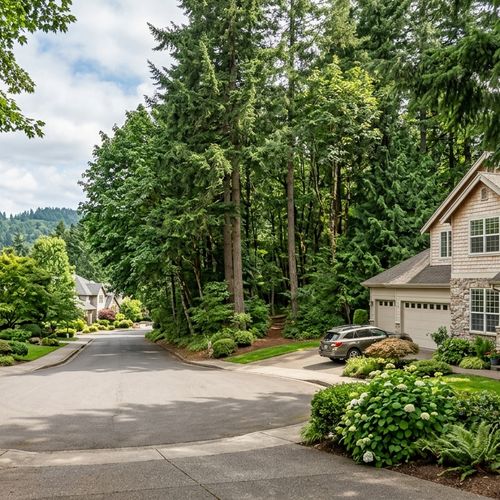



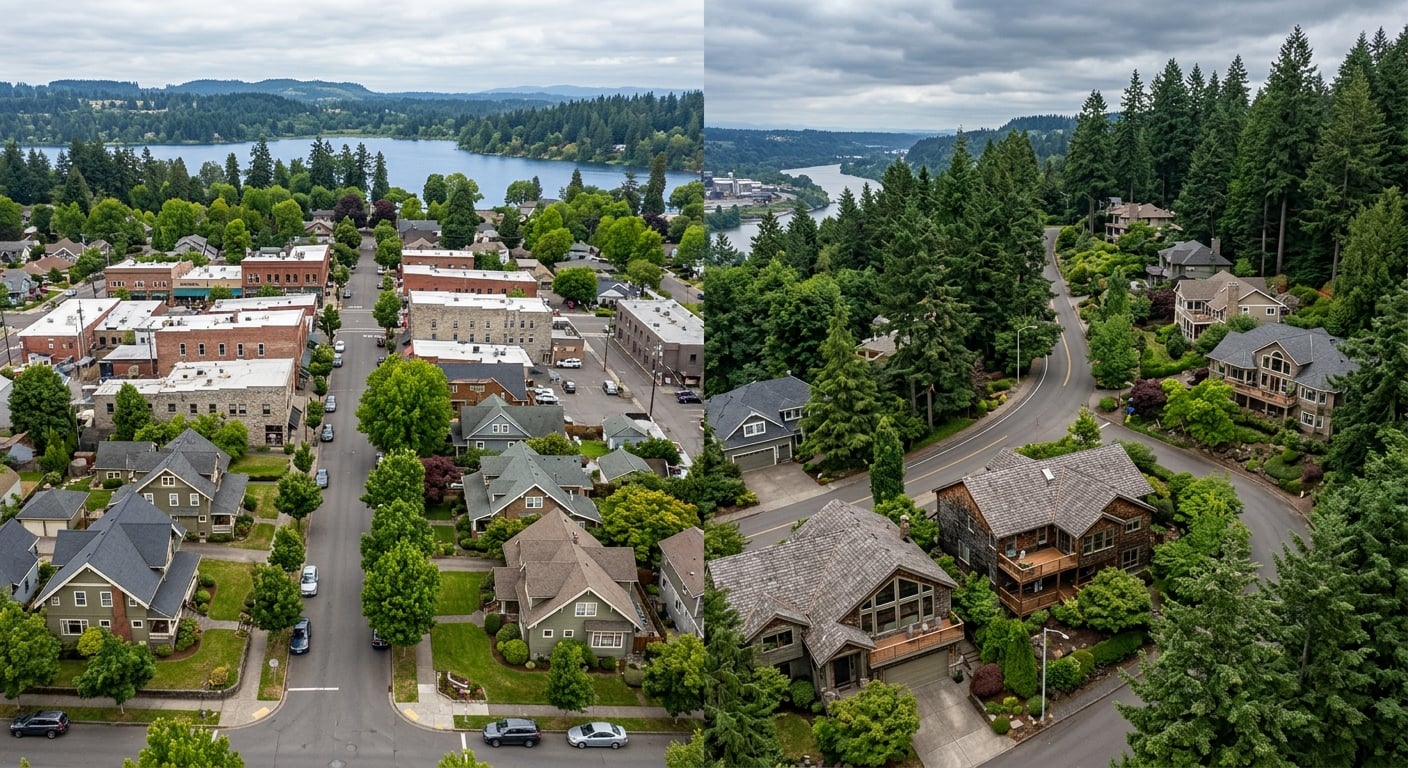
Camas and West Linn are two of the cities I work in most often, and buyers weighing one against the other ask me the same handful of questions nearly every time. Here's a direct, side-by-side look at how the two actually compare, based on what I see with real listings and real buyers.
Executive Summary
Camas, WA and West Linn, OR are both established Portland-area cities known for historic character and higher-end housing rather than new-construction sprawl.
Camas sits in Clark County, Washington, with no state income tax; West Linn sits in Clackamas County, Oregon, with no state sales tax, a real cost tradeoff worth weighing beyond home price alone.
Camas is centered on Lacamas Lake and a historic downtown; West Linn is built around the Willamette and Tualatin rivers and Willamette Falls, across hillier, more wooded neighborhoods.
As of late 2026, Camas carried a higher median sale price than West Linn, though West Linn's market had recently been moving faster.
Camas at a Glance
A walkable historic downtown along NE 4th Avenue, with local shops and restaurants that predate the city's more recent growth.
Lacamas Lake, the Lacamas Heritage Trail and Round Lake Park, all within a short drive of downtown, for lake access and year-round trail use.
No Washington state income tax, plus a long-running industrial and semiconductor manufacturing base nearby.
Direct access to SR-14 and I-205, connecting to both Vancouver and Portland's east side.
Camas School District, ranked 15th of 238 Washington school districts by SchoolDigger as of 2026 (with 8 five-star-rated schools), a real, often-cited factor in why buyers specifically target Camas.
Camas Price Points & Amenities
Median sale price: $800,000 over the trailing six months (428 closed sales), per Resideline's Camas market report (ZIP 98607) as of October 5, 2026; the middle half of sales closed between $595,000 and $965,000.
Housing stock: a mix of established single-family neighborhoods, newer subdivisions and some ongoing new construction, spanning several decades of development.
Camas community page: https://jamiemeushawrealestate.com/communities/camas/
Check out this neighborhood in Camas (Deer Creek): https://jamiemeushawrealestate.com/moving-to-camas-wa-consider-deer-creek-wooded-lots-quiet-streets-on-prune-hill/
Watch: Living in Camas, WA (YouTube playlist): https://www.youtube.com/playlist?list=PLEh0DURDVECF3CgeNR6_omDk70sG7Dzzh
West Linn at a Glance
Willamette Falls and the confluence of the Willamette and Tualatin rivers, defining features of the city's landscape and close to most neighborhoods.
An established, hillier residential character, with wooded and river-adjacent streets across neighborhoods like Robinwood, Bolton and Marylhurst.
No Oregon state sales tax, offset by Oregon's state income tax, a different cost structure than Washington's no-income-tax approach.
Direct access to I-205 and Highway 43, with a faster-moving market than Camas in the most recent data for each, per Redfin.
West Linn Price Points & Amenities
Median sale price: $747,500 as of November 2025, down 2.0% year over year, per Redfin's West Linn housing market data; price per square foot was $309, up 6.4% year over year.
Typical time on market: about 34 days, down from 56 days the year before, per the same Redfin report.
Housing stock: predominantly established single-family homes across multiple decades, concentrated in hillside and river-adjacent neighborhoods rather than large new-construction subdivisions.
West Linn community page: https://jamiemeushawrealestate.com/communities/west-linn/
Check out this neighborhood in West Linn (Hidden Springs): https://jamiemeushawrealestate.com/moving-to-west-linn-or-consider-hidden-springs-one-of-west-linns-eleven-official-neighborhoods-west-of-the-willamette/
Comparing Camas and West Linn
Camas, Washington and West Linn, Oregon sit on opposite sides of the Portland metro area (Camas northeast of Vancouver along the Columbia River, West Linn south of Portland along the Willamette), and both come up for buyers comparing established, higher-end Portland-area cities rather than newer, fast-growing suburbs. The two have more in common with each other than either does with a typical new-construction subdivision: older housing stock, a defined downtown or town center, and a reputation for being quieter than the larger cities nearby.
Camas grew up around a working waterfront. A paper mill has operated on the Columbia River there for more than a century, and the city's historic downtown along NE 4th Avenue developed around that industrial base long before Portland-area commuters started moving in. Lacamas Lake and the Lacamas Heritage Trail sit just north of downtown, and a semiconductor manufacturing facility in the surrounding area has added a newer layer to the local job base alongside the older industrial one.
West Linn's character comes from its geography rather than its industry. The city sits where the Tualatin River meets the Willamette, next to Willamette Falls (one of the largest waterfalls by volume in the United States), and its neighborhoods, among them Robinwood, Bolton and Marylhurst, are built across hillier, more wooded terrain than Camas's. The city has been an established Portland-area address for decades, with most of its housing built out well before the recent wave of new construction further out in the metro.
Price tells a more complicated story than it might look at first. As of October 2026, Camas carried a median sale price of $800,000 over the trailing six months, per Resideline's Camas market data (ZIP 98607). West Linn's median sale price was $747,500 over the same period, down 2.0% year over year, per Redfin's West Linn housing market data, with a price per square foot of $309, up 6.4% year over year; homes there were moving faster, a median of 34 days, down from 56 days a year earlier. Camas currently carries the higher sticker price, but West Linn's market was moving noticeably quicker, both numbers worth checking against current listings rather than treated as fixed.
The tax picture differs in a way that matters beyond the sale price. Washington has no state income tax, which is part of what Camas, and Clark County generally, offers buyers coming from Oregon. Oregon has no state sales tax, which is part of what West Linn, and Clackamas County, offers in return. Neither is simply cheaper outright. The right answer depends on income, spending patterns and how a buyer weighs the two tax structures against each other.
Commute patterns reflect each city's position in the metro. Camas connects to Portland and Vancouver primarily via SR-14 and I-205, putting it within reach of Portland's east side. West Linn connects via I-205 and Highway 43, putting it closer to Lake Oswego, Portland's southwest side and the broader I-5 corridor. Actual drive times in both cases depend heavily on time of day and bridge traffic, and are worth testing directly during the hours a buyer would actually be commuting rather than relying on an off-peak estimate.
Parks and outdoor recreation draw on different features in each city. Camas residents have walkable access to Lacamas Lake, the Lacamas Heritage Trail and Round Lake Park. West Linn's signature outdoor features are Willamette Falls and the river trails along the Willamette and Tualatin, along with Mary S. Young State Park. A buyer drawn to lake access and trail systems close to a historic downtown may lean toward Camas; a buyer drawn to river frontage, waterfalls and hillier wooded terrain may lean toward West Linn.
Both cities sit within their own public school districts: Camas School District, and West Linn-Wilsonville School District, which covers about 42 square miles and serves roughly 8,400 students. School boundaries and assignments can change, so buyers should verify current school assignments directly with the relevant district rather than relying on a neighborhood's general reputation.
Neither city is a clear upgrade over the other: they draw on genuinely different geography and history. Camas offers a historic downtown, lake access and no state income tax, at a higher overall price point and a somewhat slower-moving market in the most recent data available. West Linn offers river and waterfall access, hillier established neighborhoods and no state sales tax, at a lower overall price point and a faster-moving market in its own most recent data. A side-by-side look at current listings in both is the clearest way to see how those differences show up in what's actually available right now.
Should You Consider Camas or West Linn?
Both Camas and West Linn are worth a direct look for anyone comparing established Portland-area cities. The right fit comes down to budget, tax tradeoffs and which natural feature, lake or river, matters more day to day.
Work With Jamie
Jamie has been in real estate for 30 years and works with relocation buyers to compare cities, neighborhoods, commutes and property types until something actually fits, not to sell one particular neighborhood.
Book a Strategy Call: https://calendly.com/jamiemeushawrealestate
Call / Text: (360) 798-7127
Email: [email protected]
Website: https://www.jamiemeushawrealestate.com
Check out this article next