


Washington Real Estate Glossary: 300+ Terms Every Camas Buyer and Seller Should Know
Washington Real Estate Glossary: 300+ Terms Every Camas Buyer and Seller Should Know
Buying or selling in Camas means signing documents shaped by Washington law, not the generic national version you'll find online. Form 17. Mutual acceptance. Statutory warranty deed. Notice of continuance. Permit-exempt well. These words decide deadlines, money and rights, and most people see them for the first time a few hours before they're due.
I've spent 29 years helping people buy and sell homes in Camas, Vancouver and the greater Portland metro, and I put this glossary together so you can look up the terms that actually show up in a Washington transaction. Bookmark it. Send it to your parents who are downsizing. Pull it up when your lender emails you a Closing Disclosure at 9 p.m.
Important: I'm a REALTOR®, not an attorney. This glossary is general information to help you follow the conversation, not legal, tax or financial advice. Washington laws, forms and local rules change, and how they apply depends on your situation. For an explanation of your legal rights or obligations, please consult a Washington-licensed real estate attorney. For tax questions, talk with a CPA or tax advisor.
Rather just ask a person?
If a term in your paperwork isn't making sense, call or text me. I'll give you a straight answer, and if it's a legal question, I'll point you to the right attorney.
Call or Text (360) 798-7127
Email Jamie
Agency, Licensing & Getting Started
Who represents whom, and what Washington law requires before anyone opens a front door.
- Agency Law (RCW 18.86)
- The Washington statute that sets out the duties a real estate broker owes to buyers and sellers, including honesty, reasonable care, disclosure of known material facts, and loyalty to the party they represent.
- The Law of Real Estate Agency Pamphlet
- A state-required pamphlet summarizing RCW 18.86. Your broker must give you a copy, typically before or as soon as reasonably practicable after they start working with you.
- Buyer Brokerage Services Agreement
- Since January 1, 2024, Washington requires a written agreement between a buyer and their brokerage. It spells out who represents the buyer, how long the agreement lasts, whether it is exclusive, and how and by whom the broker is paid.
- Buyer's Agent
- A broker who represents the buyer's interests in a purchase, from finding homes and writing the offer to negotiating repairs and getting to closing.
- Listing Agent (Seller's Agent)
- A broker who represents the seller, handling pricing, marketing, showings, offer negotiation and the path to closing.
- Limited Dual Agency
- When one broker, or two brokers at the same firm, represent both buyer and seller in the same deal. Washington allows it only with written consent from both parties, and the broker's duties to each side are limited.
- Designated Broker
- The licensed broker who is legally responsible for a real estate firm's operations and supervision under Washington licensing law.
- Managing Broker
- A Washington license level above Broker. Managing brokers have additional experience and education and may supervise other brokers.
- Broker
- In Washington, the base real estate license title. Washington does not use the term "salesperson." Licenses are issued by the Department of Licensing.
- Department of Licensing (DOL)
- The Washington state agency that licenses and disciplines real estate brokers, appraisers and home inspectors.
- REALTOR®
- A licensed real estate professional who is a member of the National Association of REALTORS® and agrees to its Code of Ethics. Not every licensed broker is a REALTOR®.
- Fiduciary Duty
- A duty of loyalty and care. In Washington, many traditional fiduciary duties have been replaced by the specific duties listed in RCW 18.86, which is why reading the agency pamphlet matters.
- Material Fact
- Information that substantially and adversely affects the value of a property or a party's ability to perform. Brokers must disclose known material facts that are not apparent or readily discoverable.
- Washington Law Against Discrimination (WLAD)
- Washington's civil rights law (RCW 49.60). It adds protected classes beyond federal fair housing law, including sexual orientation, gender identity, honorably discharged veteran or military status, and use of a trained dog guide or service animal.
- Fair Housing
- Federal and state laws that prohibit discrimination in housing based on protected classes. It is why I describe homes and neighborhoods, never the people who should live there.
- Buyer Love Letter
- A personal letter from a buyer to a seller. Many brokers now discourage them because they can reveal protected characteristics and invite fair housing claims.
- Broker Compensation
- How the brokers in a transaction are paid. After the 2024 national settlement, buyer broker compensation is set in the buyer's written agreement and may be paid by the buyer, the seller as a concession, or both.
- Listing Agreement
- The contract between a seller and a listing brokerage authorizing the brokerage to market the property, setting the term, list price and compensation.
- Exclusive Right to Sell
- The most common listing agreement. The listing brokerage is compensated if the property sells during the term, no matter who finds the buyer.
- Referral
- When one broker sends a client to another broker, usually in another market, often for a referral fee paid broker to broker.
- Relocation Package
- Benefits an employer provides to a transferring employee, which can include home sale assistance, closing cost coverage or temporary housing.
- Transaction Coordinator
- A professional who manages paperwork, deadlines and communication behind the scenes so the broker can focus on negotiating and advising.
Questions about representation?
If you're relocating to Camas or buying your first home, the agency paperwork is where the relationship starts. I'll walk you through it in plain English before you sign anything.
Call or Text (360) 798-7127Visit JamieMeushawRealEstate.com
Back to top
Buying & Selling: Offers, Contracts & Timelines
The vocabulary of getting from "I like this house" to signed, sealed and recorded.
- Multiple Listing Service (MLS)
- The shared database brokers use to list and find properties. Clark County listings are commonly found in RMLS, and Washington brokers also use NWMLS.
- RMLS
- Regional Multiple Listing Service, the MLS serving the Portland metro area, including Clark County, Washington.
- NWMLS
- Northwest Multiple Listing Service. Beyond its listing database, it publishes the standardized purchase and sale forms widely used across Washington.
- NWMLS Form 21
- The standard Residential Purchase and Sale Agreement used for most Washington home sales. It sets out price, earnest money, closing date, possession, title and default terms.
- Purchase and Sale Agreement (PSA)
- The binding contract between buyer and seller. In Washington it is usually NWMLS Form 21 plus the addenda that fit the deal.
- Addendum
- A document attached to the purchase agreement at the time of the offer that adds terms, such as financing, inspection or sale of the buyer's home.
- Amendment
- A change to the purchase agreement after mutual acceptance, signed by both parties. NWMLS Form 34 is often used.
- Offer
- A signed proposal to buy a property on specific terms. It becomes binding only when the seller accepts and acceptance is delivered.
- Counteroffer
- A response to an offer that changes one or more terms. Legally it rejects the original offer and creates a new one.
- Mutual Acceptance
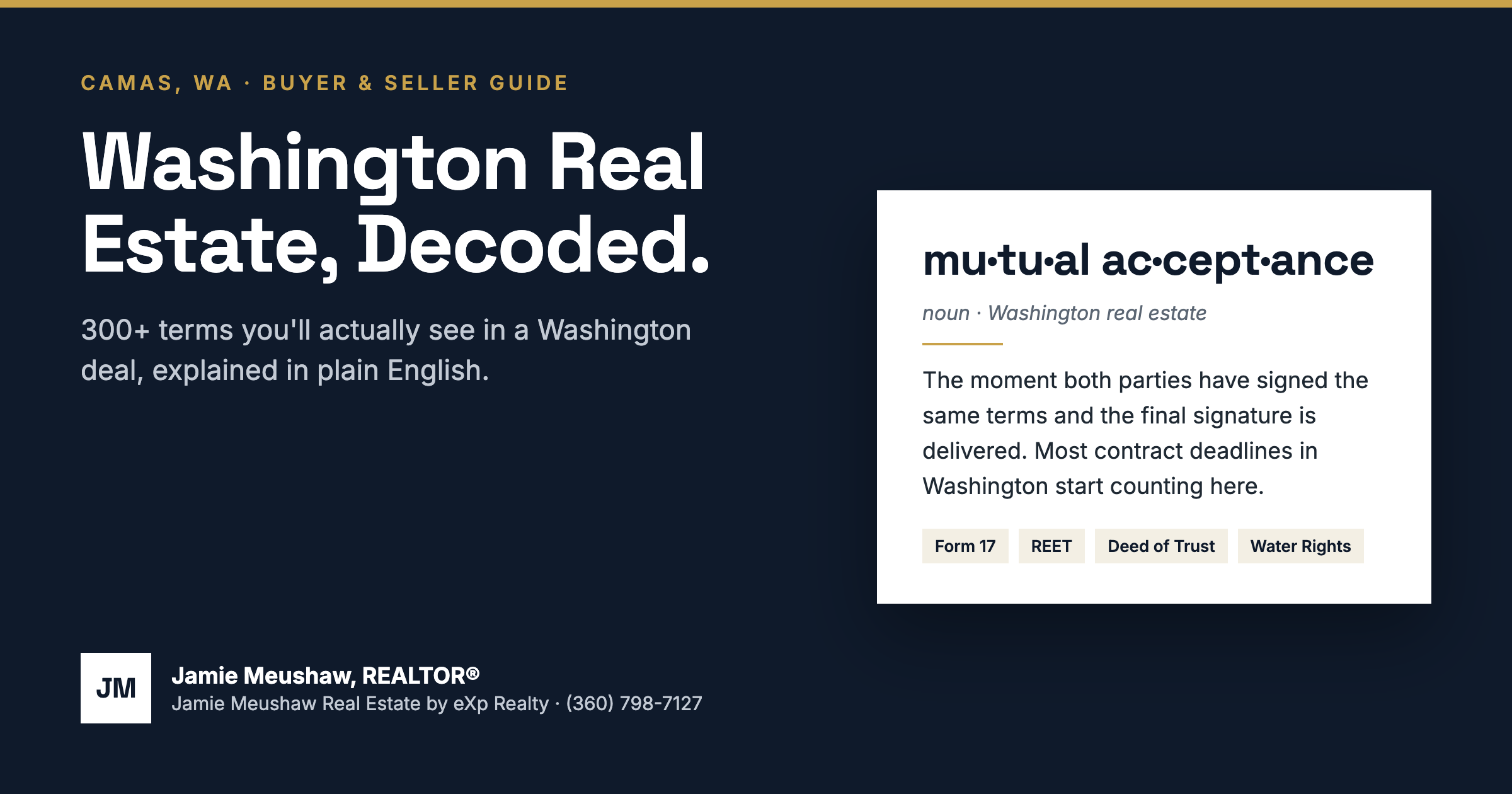
- The moment both parties have signed the same terms and the final signature is delivered to the other side. Most contract deadlines in Washington count from this date.
- Contingency
- A condition that must be satisfied or waived for the sale to move forward, such as inspection, financing, appraisal, title or the sale of the buyer's home.
- Inspection Contingency
- Gives the buyer a set number of days after mutual acceptance to have the home inspected and to accept, negotiate repairs or terminate. In Washington this is typically NWMLS Form 35.
- Financing Contingency
- Lets the buyer terminate and recover earnest money if they cannot obtain the loan described in the agreement. In Washington this is typically NWMLS Form 22A.
- Appraisal Contingency
- Protects the buyer if the property appraises below the purchase price, allowing renegotiation or termination within the contract's terms.
- Sale of Buyer's Home Contingency
- Makes the purchase dependent on the buyer selling their current home. Often includes a "bump" right that lets the seller keep marketing and accept another offer.
- Bump Clause
- Part of a sale-of-home contingency that lets the seller accept a backup offer and give the first buyer a short window to remove the contingency or step aside.
- Neighborhood Review Contingency
- A short window in Washington inspection paperwork for the buyer to research the neighborhood, including offender registries and local conditions, and terminate if dissatisfied.
- Feasibility Contingency
- Common with land and rural purchases. Gives the buyer time to verify zoning, utilities, septic feasibility, wells, permits and access before committing.
- Title Contingency
- The buyer's right to review the preliminary title commitment and object to exceptions before closing.
- Escalation Clause
- An addendum that automatically raises the buyer's price above competing offers by a set increment, up to a cap. Useful in multiple-offer situations, but it reveals your ceiling.
- Multiple Offers
- When a seller receives more than one offer at the same time. Price is only one lever; terms, timing and certainty often decide the winner.
- Backup Offer
- An accepted offer that moves into first position if the primary sale fails.
- Earnest Money
- A good-faith deposit made by the buyer after mutual acceptance, usually held by escrow or the buyer's brokerage, and credited to the buyer at closing.
- Liquidated Damages
- A pre-agreed remedy for buyer default. In Washington, a seller keeping earnest money as liquidated damages is generally capped at 5% of the purchase price.
- Specific Performance
- A legal remedy where a court orders a party to complete the sale rather than pay damages.
- Default
- Failure by a buyer or seller to perform an obligation under the contract.
- Time Is of the Essence
- A contract clause making deadlines strict. Missing one can cost you a right or allow the other party to terminate.
- Notice
- Formal written communication required under the contract, such as removing a contingency. It must be delivered as the agreement specifies to count.
- Termination
- Ending the agreement under a right it provides, such as an unmet contingency.
- Earnest Money Release
- A signed agreement directing who receives earnest money when a sale fails. Escrow usually will not release funds without it or a court order.
- Closing Date
- In Washington, generally the date the deed is recorded and sale proceeds are available to the seller, not the day you sign.
- Possession Date
- When the buyer gets the keys. Often on closing date, but it can be negotiated for later.
- Rent-Back
- An agreement letting the seller stay in the home after closing for a set period, usually with a written occupancy agreement and deposit.
- Final Walk-Through
- The buyer's last look at the property before closing to confirm its condition and that agreed repairs were completed.
- Comparative Market Analysis (CMA)
- A broker's analysis of recent comparable sales, pending and active listings used to recommend a list price or offer price.
- Days on Market (DOM)
- How long a listing has been active. In Camas, the price band and location matter more than the averages you see online.
- Coming Soon
- A listing status announcing a property before it is available to show, subject to MLS rules.
- Clear Cooperation Policy
- A national MLS policy requiring that a property publicly marketed be submitted to the MLS within a short time frame.
- Pocket Listing
- A property marketed privately without entering the MLS. It can limit exposure and often limits price.
- For Sale By Owner (FSBO)
- A home sold without a listing broker. Sellers still face all of Washington's disclosure requirements.
- Seller Net Sheet
- An estimate of what a seller walks away with after payoffs, excise tax, title, escrow, broker fees and concessions.
- Seller Concession
- Money the seller agrees to put toward the buyer's closing costs, prepaid items or rate buydown.
- As-Is
- A sale where the seller will not make repairs. It does not erase the seller's legal disclosure obligations.
- Short Sale
- A sale where the lender agrees to accept less than the amount owed. Requires lender approval, which adds time.
- REO (Bank-Owned)
- A property the lender took back through foreclosure and is now selling, typically as-is with lender-specific addenda.
- Probate Sale
- A sale handled by the personal representative of a deceased owner's estate, sometimes requiring court involvement.
- 1031 Exchange
- A federal tax-deferral strategy for investment property where proceeds are reinvested into like-kind property through a qualified intermediary within strict deadlines.
- FIRPTA
- The Foreign Investment in Real Property Tax Act. Requires withholding on many sales by foreign sellers. Every Washington seller certifies status at closing.
- Power of Attorney
- A document authorizing someone to sign for another person. Lenders and escrow must approve it in advance.
- New Construction Purchase Agreement
- A builder-drafted contract for a newly built home. It often differs significantly from Form 21, so read it carefully and have representation.
- An extra charge a builder adds for a desirable homesite, like a view, corner or greenbelt lot.
- Home Warranty
- A service contract covering repair or replacement of certain systems and appliances for a set term. Different from a builder's structural warranty.
Writing an offer in Camas?
Winning here is rarely about price alone. I've negotiated more than 1,000 transactions, and the right terms often beat the highest number. Let's build an offer that gets accepted and holds together.
Find Out What Your Home Is WorthCall or Text Jamie
Back to top
Escrow, Closing & Title
Washington closes in escrow, records with the county, and protects ownership through title insurance. Here's the language you'll hear.
- Escrow
- A neutral third party holds funds and documents and closes the transaction according to the parties' instructions.
- Escrow Agent
- A company or individual licensed by the Washington Department of Financial Institutions under RCW 18.44 to close real estate transactions.
- Limited Practice Officer (LPO)
- A Washington-specific license, overseen by the Washington Supreme Court, that allows non-attorneys to prepare certain closing documents like deeds and deeds of trust.
- Escrow Instructions
- The written directions signed by buyer and seller telling escrow how to close.
- Escrow Fee
- The charge for escrow services. In Clark County it is customarily split between buyer and seller, but it is negotiable.
- Settlement Statement
- The itemized accounting of every credit and charge for buyer and seller at closing.
- Proration
- Dividing ongoing costs such as property taxes and HOA dues between buyer and seller based on the closing date.
- Holdback
- Funds held by escrow after closing to cover an unfinished repair or obligation.
- Wire Fraud
- Criminals impersonate escrow or brokers by email and send fake wiring instructions. Always verify wiring instructions by calling a known phone number.
- Signing Appointment
- When buyers or sellers sign closing documents before a notary, usually a day or more before recording.
- Recording
- Filing the deed and deed of trust with the county. In Clark County, the County Auditor's office records documents.
- eRecording
- Electronic submission of documents to the county for recording, now common in Clark County.
- Funding
- When the lender releases loan funds to escrow so the transaction can record and close.
- Title
- Legal ownership of real property and the bundle of rights that comes with it.
- Title Insurance
- A one-time premium policy protecting against covered defects in title that existed before you bought.
- Owner's Policy
- Title insurance that protects the buyer. In Washington, the seller customarily pays for the standard owner's policy, though this is negotiable.
- Lender's Policy
- Title insurance protecting the lender's loan, typically paid by the buyer.
- Standard vs. Extended Coverage
- Standard coverage insures against defects found in public records. Extended (ALTA) coverage adds protection for matters a survey or inspection would reveal, like boundary encroachments.
- Preliminary Title Commitment
- The title company's report, issued early in the transaction, showing current ownership, liens, easements and the exceptions to coverage.
- Schedule A
- The section of the title commitment listing the proposed insured, the policy amount and the legal description.
- Schedule B Exceptions
- Items the title policy will not cover, such as recorded easements, CC&Rs and taxes. Read these; they often explain more about a property than the listing does.
- Chain of Title
- The recorded history of ownership transfers for a property.
- Cloud on Title
- Any claim or document that casts doubt on clear ownership and must be resolved before closing.
- Lien
- A legal claim against property to secure a debt, such as a mortgage, tax lien or judgment.
- Construction Lien (Mechanic's Lien)
- In Washington (RCW 60.04), a lien filed by contractors or suppliers who were not paid for improvements to the property.
- Judgment Lien
- A lien created when a court judgment is recorded against a property owner.
- Lis Pendens
- A recorded notice that a lawsuit involving the property is pending.
- Easement
- A right for someone else to use part of your property for a specific purpose, like utilities, drainage or a shared driveway.
- Encroachment
- A structure or improvement that crosses onto a neighbor's property or an easement, like a fence or shed.
- Legal Description
- The precise description of a property's boundaries used in deeds, based on lot and plat or metes and bounds.
- Parcel Number (APN)
- The number the county assigns to each parcel for tax and record purposes. Clark County's property information center searches by parcel number.
- Plat
- A recorded map dividing land into lots, streets and easements, often with notes that restrict use.
- Survey
- A licensed surveyor's measurement and mapping of property boundaries and improvements.
- Statutory Warranty Deed
- The standard deed in Washington residential sales (RCW 64.04.030). The seller warrants clear title against all claims, except those listed.
- Bargain and Sale Deed
- A Washington deed (RCW 64.04.040) that conveys property and implies the seller has not personally encumbered it, with fewer warranties than a warranty deed.
- Quitclaim Deed
- A deed that transfers whatever interest the grantor has, with no warranties. Common between family members or spouses.
- Personal Representative's Deed
- A deed used by the court-appointed representative of an estate to convey property.
- Transfer on Death Deed
- Under Washington law (RCW 64.80), a recorded deed that passes property to a named beneficiary at death without probate.
- Vesting
- How buyers hold title, such as a married couple as community property, or friends as tenants in common.
- Community Property
- Washington is a community property state. Property acquired during marriage or registered domestic partnership is generally owned equally, and both spouses usually must sign to sell or encumber it.
- Separate Property
- Property owned before marriage or received by gift or inheritance, generally belonging to one spouse alone.
- Tenants in Common
- Co-ownership where each owner holds a share that can be sold or inherited separately.
- Joint Tenancy with Right of Survivorship
- Co-ownership where a deceased owner's share passes automatically to the surviving owners.
- Quiet Title Action
- A lawsuit to establish clear ownership and remove competing claims.
- Adverse Possession
- A way to gain title by open, continuous, hostile use of another's land. In Washington the period is generally 10 years, or 7 with color of title and payment of taxes.
- Reconveyance
- The document a trustee records to release a deed of trust after the loan is paid off.
- Payoff Statement
- The lender's written figure to pay a loan in full as of a specific date.
- Homestead Exemption
- Washington law (RCW 6.13) protects a portion of a primary residence's equity from certain creditors, up to the greater of $125,000 or the county's prior-year median home price.
- 1099-S
- The IRS form escrow files reporting the gross proceeds of a real estate sale.
Getting close to closing?
I stay on top of escrow, title and lender deadlines so nothing surprises you at the signing table. Call or text me with questions about any document you've received.
Search Camas HomesEmail Jamie
Back to top
Financing & Mortgage Terms
Loans, rates and the paperwork lenders send you at 9 p.m. on a Thursday.
- Prequalification
- A lender's informal estimate of what you might borrow based on information you provide. Useful, but not strong enough to win a competitive offer.
- Pre-Approval
- A lender's conditional commitment based on verified income, assets and credit. This is what makes an offer credible.
- Mortgage Loan Originator (MLO)
- The licensed individual who takes your loan application. In Washington they are licensed through DFI and listed on NMLS.
- Deed of Trust
- Washington's standard security instrument. The borrower (grantor) conveys title to a trustee to secure the loan for the lender (beneficiary).
- Promissory Note
- The borrower's written promise to repay the loan, separate from the deed of trust that secures it.
- Trustee
- The neutral party named in a deed of trust who holds the power of sale and reconveys when the loan is paid.
- Non-Judicial Foreclosure
- Washington's Deeds of Trust Act (RCW 61.24) lets a trustee foreclose through a trustee's sale without a court case, following strict notice requirements.
- Foreclosure Mediation
- Washington's Foreclosure Fairness Act gives eligible homeowners access to mediation with their lender before a trustee's sale.
- Real Estate Contract
- A Washington seller-financing tool where the buyer makes payments to the seller and receives the deed when paid in full. Remedies are governed by RCW 61.30.
- Conventional Loan
- A mortgage not insured by a government agency, generally following Fannie Mae or Freddie Mac guidelines.
- Conforming Loan
- A conventional loan within the loan limits set for the county. Clark County falls under the Portland metro limits.
- Jumbo Loan
- A loan above the conforming limit, common at upper Camas price points, usually with stricter reserves and credit requirements.
- FHA Loan
- A Federal Housing Administration insured loan with low down payment options and more flexible credit standards.
- VA Loan
- A loan guaranteed by the Department of Veterans Affairs for eligible veterans and service members, often with no down payment.
- USDA Loan
- A zero-down loan for eligible rural areas and incomes. Some outlying parts of Clark County qualify; most of the City of Camas does not.
- WSHFC Home Advantage
- A Washington State Housing Finance Commission program offering first mortgages with down payment assistance through participating lenders.
- Down Payment Assistance (DPA)
- Grants or second loans that help buyers with down payment or closing costs, often with income or purchase-price limits.
- Down Payment
- The portion of the purchase price paid in cash rather than borrowed.
- Loan-to-Value (LTV)
- The loan amount divided by the property's value. Lower LTV usually means better pricing.
- Debt-to-Income Ratio (DTI)
- Your monthly debt payments divided by gross monthly income. Lenders use it to set what you can borrow.
- Credit Score
- A numerical summary of credit history that affects loan approval and interest rate.
- Private Mortgage Insurance (PMI)
- Insurance required on most conventional loans with less than 20% down. It can usually be removed as equity grows.
- The FHA version of mortgage insurance, with an upfront and an annual component.
- VA Funding Fee
- A one-time fee on VA loans that can be financed. Some veterans are exempt.
- Fixed-Rate Mortgage
- A loan with the same interest rate for its entire term.
- Adjustable-Rate Mortgage (ARM)
- A loan with a fixed introductory rate that later adjusts based on an index plus a margin.
- Interest Rate
- The cost of borrowing, expressed as a yearly percentage of the loan amount.
- Annual Percentage Rate (APR)
- The yearly cost of the loan including the rate plus certain fees. Use it to compare offers from different lenders.
- Discount Points
- Upfront fees paid to lower the interest rate. One point equals 1% of the loan amount.
- Temporary Buydown (2-1 Buydown)
- Funds paid upfront, often by the seller, that lower the rate for the first year or two of the loan.
- Rate Lock
- A lender's guarantee of a specific rate for a set period while the loan is processed.
- Loan Estimate
- A standardized federal form showing estimated loan terms and closing costs, due within three business days of application.
- Closing Disclosure
- The final federal form showing loan terms and costs. You must receive it at least three business days before you sign loan documents.
- Underwriting
- The lender's review of your income, assets, credit and the property to approve the loan.
- Conditional Approval
- Underwriting approval subject to remaining items, like updated pay stubs or an explanation letter.
- Clear to Close
- Underwriting has signed off and the loan is ready for documents and signing.
- Appraisal
- A licensed appraiser's opinion of market value, ordered by the lender.
- Appraisal Gap
- The difference between a lower appraised value and the contract price, which the buyer may need to cover in cash or renegotiate.
- Gift Letter
- A signed statement from a family member confirming money given for a down payment is a gift, not a loan.
- Proof of Funds
- Documentation, like a bank statement, showing a buyer has the cash for a purchase or down payment.
- Cash to Close
- The total amount the buyer must bring to closing after credits, deposits and loan proceeds.
- Closing Costs
- Fees and charges beyond the price, including lender fees, title, escrow, recording and prepaid items.
- Prepaids
- Costs paid at closing in advance, like homeowners insurance, interest and initial tax and insurance reserves.
- Escrow (Impound) Account
- An account your loan servicer uses to collect monthly amounts and pay property taxes and insurance for you.
- PITI
- Principal, interest, taxes and insurance, the four pieces of a typical monthly mortgage payment.
- Amortization
- Paying down a loan through regular payments of principal and interest over time.
- Assumable Loan
- A loan, often FHA or VA, that a qualified buyer can take over with its existing interest rate.
- Bridge Loan
- Short-term financing that lets you buy your next home before selling your current one.
- Home Equity Line of Credit (HELOC)
- A revolving credit line secured by your home's equity.
- Cash-Out Refinance
- Replacing your mortgage with a larger loan and taking the difference in cash.
- Reverse Mortgage (HECM)
- An FHA-insured loan for homeowners 62 and older that converts equity into payments or a credit line without monthly mortgage payments.
- Prepayment Penalty
- A fee for paying off a loan early. Rare on today's residential loans but worth checking.
Not sure what you can afford in Camas?
I can connect you with local lenders who close on time and understand Clark County's price points, from starter townhomes to Prune Hill view properties.
Call or Text (360) 798-7127Visit JamieMeushawRealEstate.com
Back to top
Inspections, Disclosures & Condition
Pacific Northwest homes deal with rain, moss, crawlspaces and a few decades of building practices. These are the terms that show up in the report.
- Seller Disclosure Statement (Form 17)
- Washington's required disclosure for most residential sales under RCW 64.06. The seller answers questions about title, water, sewer, structure, systems and environmental issues.
- Right to Rescind After Form 17
- In Washington, a buyer generally has three business days after receiving the Form 17 to rescind the agreement, unless that right was waived.
- Form 17 for Unimproved Land
- A version of the seller disclosure used for vacant land, covering access, utilities, soils, wells, septic feasibility and environmental issues.
- Exempt Sales
- Certain sales, such as some foreclosures, court-ordered or estate transfers, are exempt from Form 17, though other legal duties may still apply.
- Material Defect
- A problem that significantly affects value or poses an unreasonable risk to people. Known material defects must be disclosed.
- Latent Defect
- A hidden defect not discoverable by reasonable inspection, like a cracked sewer line under the driveway.
- Lead-Based Paint Disclosure
- A federal requirement for homes built before 1978. Sellers disclose known lead hazards and buyers get an opportunity to test.
- Home Inspection
- A visual examination of a home's accessible systems and components by a licensed inspector.
- Washington Licensed Home Inspector
- Washington requires home inspectors to be licensed under RCW 18.280 through the Department of Licensing.
- Pre-Listing Inspection
- An inspection the seller orders before listing to surface issues early and price accordingly.
- Inspection Response
- The buyer's written notice after inspection to accept, request repairs or credits, or terminate.
- Repair Credit
- A price reduction or closing cost credit in lieu of the seller making repairs.
- Re-Inspection
- A follow-up visit to confirm agreed repairs were completed properly.
- Wood Destroying Organism (WDO) Inspection
- An inspection for rot, carpenter ants, termites and beetles. In Washington, structural pest inspectors are licensed by the Department of Agriculture.
- Dry Rot
- Fungal decay in wood, common in Pacific Northwest homes where moisture lingers around windows, decks and siding.
- Carpenter Ants
- Common Northwest pest that nests in damp wood. Not a sign of moisture by itself, but often a symptom of it.
- Sewer Scope
- A camera inspection of the side sewer line from the house to the street. Root intrusion and offsets are common in older Camas neighborhoods.
- Side Sewer
- The private sewer line from your home to the public main. In most cases the homeowner owns and maintains it.
- Radon
- A naturally occurring radioactive gas. Testing is inexpensive and is the only way to know a home's levels.
- Mold
- Fungal growth from excess moisture. Look for the source of the moisture, not just the stain.
- Moisture Intrusion
- Water entering through roofs, windows, siding or foundations, the most common root cause of Northwest home repairs.
- Crawlspace
- The space under a home with a raised foundation. Typical in the Northwest; inspectors check for standing water, insulation and pests.
- Vapor Barrier
- Plastic sheeting over a crawlspace floor that limits ground moisture from entering the home.
- Efflorescence
- White mineral deposits on concrete or masonry left by evaporating water, a clue that moisture is moving through.
- Grading and Drainage
- How the ground slopes around the home. Soil should slope away from the foundation.
- Roof Moss
- Moss growth common in shaded Northwest roofs. It holds moisture and can shorten roof life.
- Gutters and Downspouts
- Systems that carry roof water away from the house. Downspouts that dump next to the foundation cause many crawlspace problems.
- GFCI
- Ground fault circuit interrupter outlets that cut power to prevent shock in wet locations like kitchens, baths and exteriors.
- AFCI
- Arc fault circuit interrupter breakers that help prevent electrical fires, required in many rooms by modern code.
- Double-Tapped Breaker
- Two wires connected to a breaker designed for one, a common electrical inspection finding.
- Problem Electrical Panels
- Certain older panel brands, including Federal Pacific Stab-Lok and Zinsco, are often flagged for replacement by inspectors and insurers.
- Knob and Tube Wiring
- Early electrical wiring found in some pre-1940s homes, often difficult to insure.
- Polybutylene Pipe
- Gray plastic supply piping used from the late 1970s to the mid-1990s that is prone to failure.
- Galvanized Pipe
- Older steel water piping that corrodes from the inside, reducing water pressure over time.
- Asbestos
- A mineral used in older insulation, flooring, popcorn ceilings and siding. Usually safe if undisturbed; testing is needed before remodels.
- Underground Oil Tank
- Older Northwest homes were often heated with oil stored in buried tanks. Buyers should ask about tank decommissioning records and consider a tank sweep.
- Tank Sweep
- A scan of the yard for buried oil tanks, often recommended for homes built before the 1970s.
- Carbon Monoxide Alarm
- Washington law requires carbon monoxide alarms in residences, and existing owner-occupied homes generally must have them installed before a sale.
- Smoke Detector
- Required in sleeping areas and hallways. Brokers often confirm working detectors before closing.
- Water Heater Strapping
- Seismic straps that secure a water heater to the wall, required in Washington for earthquake safety.
- Chimney Inspection
- A Level 2 inspection with a camera, often recommended at sale, checks flue liners, cracks and creosote buildup.
- Seismic Retrofit
- Bolting a home to its foundation and bracing cripple walls to reduce earthquake damage.
- Cascadia Subduction Zone
- The offshore fault capable of a major Pacific Northwest earthquake. It is why seismic strapping and earthquake insurance come up in Washington.
Selling an older Camas home?
A pre-listing inspection and a smart Form 17 strategy can save you a painful renegotiation later. I'll tell you what buyers will flag before they find it.
Find Out What Your Home Is WorthCall or Text Jamie
Back to top
Property Taxes & Excise Tax
What you pay to buy, sell and own in Clark County, and the programs that can lower the bill.
- Real Estate Excise Tax (REET)
- Washington's tax on the sale of real property, customarily paid by the seller. The state portion is graduated by price tier, and cities like Camas add a local portion.
- REET Affidavit
- The form filed with the county at closing reporting the sale price and calculating excise tax.
- Property Tax
- An annual tax on real property based on assessed value. In Clark County, bills are mailed in February.
- Clark County Assessor
- The office that determines assessed values for all property in the county.
- Clark County Treasurer
- The office that bills and collects property taxes.
- Assessed Value
- The value the Assessor places on your property for tax purposes. It is not an appraisal and may differ from market value.
- Levy Rate
- The tax rate applied to assessed value, expressed per $1,000. It combines state, county, city, school, fire and other districts.
- Tax Code Area
- A geographic area with a unique combination of taxing districts, which is why homes in Camas can have different levy rates.
- 1% Levy Limit
- A Washington limit on how much a taxing district's total regular levy can grow each year without voter approval. It limits district revenue, not individual tax bills.
- Voter-Approved Levy
- A special tax approved by voters, such as school enrichment and capital levies in the Camas School District.
- Property Tax Due Dates
- In Washington, the first half is generally due April 30 and the second half October 31.
- Board of Equalization
- The county board that hears property owners' appeals of assessed value. Deadlines are strict.
- Senior and Disabled Exemption
- A Washington program (RCW 84.36.381) that reduces property taxes for qualifying seniors, people with disabilities and disabled veterans who meet income limits.
- Property Tax Deferral
- Programs allowing qualifying homeowners to postpone payment of some property taxes, secured by a lien.
- Current Use Program
- Washington (RCW 84.34) lets qualifying open space, farm and agricultural, and timber land be taxed on current use rather than market value.
- Designated Forest Land
- A separate Washington classification (RCW 84.33) for land managed for timber, taxed at reduced values.
- Compensating Tax
- Back taxes, interest and sometimes penalties due when land is removed from current use or forest land classification. Can be a five-figure surprise for buyers of acreage.
- Notice of Continuance
- A form a new owner signs at closing to keep land in a current use or forest program. Missing it can trigger compensating tax.
- Local Improvement District (LID)
- A special assessment district that pays for local improvements like sewers or roads, billed to benefiting properties.
- Special Assessment
- A charge on property for a specific improvement or service, separate from regular property tax.
- No State Income Tax
- Washington has no personal state income tax on wages, a major reason many Portland-area buyers look at Clark County.
- Washington Capital Gains Tax
- Washington's capital gains tax on certain long-term gains generally excludes real estate sales. Talk to a tax professional about your situation.
Moving from Portland?
Lower taxes on your paycheck is one of the biggest reasons buyers cross the river. I'll help you compare the real cost of owning in Camas against Oregon, line by line.
Search Camas HomesEmail Jamie
Back to top
HOA, Condo & Community Association Terms
Much of Camas, from Prune Hill to Grass Valley and newer plats east of Lacamas Lake, sits inside an association. Know the rules before you sign.
- Homeowners Association (HOA)
- An organization that manages common areas and enforces community rules in a planned development.
- Homeowners' Association Act (RCW 64.38)
- The Washington law that has governed many HOAs formed before July 2018.
- Condominium Act (RCW 64.34)
- The Washington law governing condominiums created between 1990 and July 2018.
- WUCIOA (RCW 64.90)
- The Washington Uniform Common Interest Ownership Act. It governs communities created after July 1, 2018, and recent legislation extends it to older communities over the next few years.
- Common Interest Community
- Any community, including HOAs, condos and co-ops, where owners share obligations for common property.
- Declaration
- The recorded document that creates a community and sets the rights and obligations of owners.
- CC&Rs
- Covenants, Conditions and Restrictions. The recorded rules on use, appearance, rentals, pets, parking and more.
- Bylaws
- The rules governing how the association operates, including elections, meetings and voting.
- Rules and Regulations
- Board-adopted rules that add detail to the CC&Rs, like trash can placement or pool hours.
- Architectural Review Committee (ARC)
- The committee that approves exterior changes such as paint colors, fences, decks and additions.
- HOA Dues
- Regular assessments owners pay to fund operations and reserves.
- HOA Special Assessment
- A one-time charge for a major expense not covered by reserves.
- Reserve Study
- An analysis of major common components and how much the association should save to repair or replace them.
- Reserve Fund
- Money saved for long-term repairs like roofs, paving or siding.
- Resale Certificate
- A document the association provides when a unit sells, disclosing dues, assessments, reserves, litigation and rules. Under WUCIOA, a buyer generally may cancel within five days of receiving it.
- Common Elements
- Areas owned or maintained by the association, like clubhouses, trails or landscaped entries.
- Limited Common Elements
- Common areas reserved for one owner's use, like a condo's assigned parking space or balcony.
- Master Association
- An umbrella association over several sub-associations in a large community.
- Capital Contribution
- A fee many associations charge buyers at closing to fund reserves or operations.
- HOA Lien
- Associations can record a lien for unpaid assessments, and some condo assessments have priority over a first mortgage for a limited period.
- Rental Restriction
- A CC&R limit on leasing, such as minimum lease terms or caps on the number of rentals.
- Solar Panel Rules
- Washington law limits an HOA's ability to ban solar panels outright, though reasonable placement rules may apply.
Comparing HOA communities?
Dues, reserves and rental rules vary a lot from one Camas neighborhood to the next. I'll help you read the resale certificate before your cancellation window closes.
Call or Text (360) 798-7127Visit JamieMeushawRealEstate.com
Back to top
Building, Zoning & Land Use
Washington's Growth Management Act shapes where and how Camas grows. These terms explain what you can build, add or change.
- Growth Management Act (GMA)
- Washington's 1990 law requiring fast-growing counties and cities to plan for growth, protect critical areas and concentrate development in urban areas.
- Urban Growth Area (UGA)
- The boundary where urban development is encouraged under the GMA. Camas's UGA defines where city services and higher densities can extend.
- Comprehensive Plan
- A city or county's long-range plan for land use, transportation, housing and utilities.
- Zoning
- Local rules that set allowed uses, density, lot sizes and building standards. In Camas, the city's zoning map controls what you can do inside city limits.
- Setbacks
- Minimum distances buildings must be from property lines, streets or critical areas.
- Lot Coverage
- The percentage of a lot that buildings may cover.
- Impervious Surface
- Hard surfaces like roofs, driveways and patios that shed water. Limits are often tied to stormwater rules.
- Accessory Dwelling Unit (ADU)
- A secondary living unit on the same lot as a house. Washington law now requires cities to allow up to two ADUs per lot in most urban residential zones.
- Middle Housing
- Duplexes, triplexes, townhomes and cottage housing. Washington's middle housing law requires many cities, including Camas, to allow more than one unit on most residential lots.
- Short Plat
- A Washington process for dividing land into a small number of lots with a simpler review than a full subdivision.
- Subdivision (Long Plat)
- The formal process of dividing land into many lots, requiring public review and infrastructure.
- Boundary Line Adjustment
- A process to move lot lines between adjacent parcels without creating new lots.
- Building Permit
- Approval from the city or county required for new construction, additions and many remodels.
- Unpermitted Work
- Improvements done without required permits. It can affect insurance, financing, appraisals and future resale.
- Certificate of Occupancy
- The document issued when construction passes final inspection and the building may be occupied.
- Washington State Building Code
- Washington adopts national model codes, like the International Residential Code, with state amendments through the State Building Code Council.
- Washington State Energy Code
- Some of the strictest energy rules in the country, shaping insulation, windows and heating systems in new construction, with a strong push toward heat pumps.
- Heat Pump
- An efficient electric system that heats and cools by moving heat. Standard in most new Washington construction.
- Ductless Mini-Split
- A heat pump without ductwork, popular in older homes and ADUs.
- Impact Fees
- One-time fees charged on new construction to fund schools, parks and traffic improvements. In Camas these can be significant on new homes and ADUs.
- SEPA
- The State Environmental Policy Act, which requires environmental review for many development proposals.
- Critical Areas
- Wetlands, steep slopes, flood zones, fish habitat and aquifer recharge areas protected under the GMA, often with buffers that limit building.
- Geologic Hazard Area
- Land subject to landslides, erosion or seismic risk. Some Camas hillsides and river bluffs carry this designation.
- Wetland Buffer
- A protected strip around a wetland where development is restricted.
- Shoreline Master Program
- Local rules under Washington's Shoreline Management Act. Lacamas Lake, the Washougal River and the Columbia all fall under shoreline regulations.
- Floodplain
- Land at risk of flooding. Properties in mapped flood zones may require flood insurance with federally backed loans.
- Stormwater Facility
- Ponds, swales and systems that manage runoff. Many newer Camas plats have HOA-maintained stormwater tracts.
- Manufactured Home
- A factory-built home meeting the federal HUD code. Washington allows titles to be eliminated so the home is treated as real property.
- Daylight Basement
- A basement with at least one wall partly above grade, common on sloped Camas lots.
- Fiber Cement Siding
- Durable siding made from cement and wood fiber, widely used in Northwest construction.
- T1-11 Siding
- Plywood panel siding common in older homes. It can delaminate and rot without good paint and drainage.
Thinking about an ADU or a lot with potential?
Washington's new housing laws are opening doors in Camas. I'll help you figure out what a property can become before you buy it.
Find Out What Your Home Is WorthCall or Text Jamie
Back to top
Water Rights, Wells & Septic
If you're looking at acreage around Fern Prairie, Livingston Mountain or the hills above Washougal, water and septic can make or break the deal.
- Water Right
- In Washington, the legal right to use water, generally granted through a permit and certificate from the Department of Ecology.
- Prior Appropriation
- Washington's "first in time, first in right" water system. Older rights have priority over newer ones in a shortage.
- Department of Ecology
- The state agency that issues and manages water rights, oversees wells and regulates shorelines.
- Water Right Certificate
- The document confirming a perfected water right, including quantity and place of use.
- Water Right Claim
- A filing in the state's registry for water use that began before the permit system existed. A claim is not proof the right is valid.
- Relinquishment
- Washington's "use it or lose it" rule. A water right not used for five consecutive years without a valid excuse may be lost.
- Permit-Exempt Well
- Washington allows certain wells without a water right permit, including domestic use up to 5,000 gallons per day, subject to local and watershed limits.
- Streamflow Restoration Act
- The 2018 Washington law (RCW 90.94) responding to the Hirst decision. It set watershed-based rules for new permit-exempt wells.
- Hirst Decision
- A 2016 Washington Supreme Court decision requiring counties to verify water is legally available before approving building on new wells, later addressed by the Streamflow Restoration Act.
- WRIA
- Water Resource Inventory Area. Camas sits within WRIA 28, the Salmon-Washougal watershed.
- Well Log
- The Department of Ecology record showing a well's depth, construction and test results.
- Well Flow Test
- A test measuring how many gallons per minute a well produces over time.
- Water Quality Test
- A lab test for bacteria, nitrates and other contaminants. Lenders often require one on private wells.
- A recorded agreement between properties sharing one well, covering access, maintenance and cost sharing.
- Group A Water System
- A public water system serving 15 or more connections or 25 or more people regularly, regulated by the state Department of Health.
- Group B Water System
- A smaller public water system serving fewer connections, regulated by the state and county.
- Water Purveyor
- The utility or entity providing water service, such as the City of Camas or Clark Public Utilities.
- Trust Water Rights Program
- A Department of Ecology program that can hold water rights in trust to protect them from relinquishment or restore streamflow.
- On-Site Sewage System (OSS)
- The technical term for a septic system. In Clark County, Clark County Public Health oversees permitting and records.
- Septic Inspection
- An evaluation of the tank, components and drainfield, often including pumping. Strongly recommended for any home on septic.
- Drainfield
- The area where treated wastewater is dispersed into the soil. Replacing one can be very expensive.
- Reserve Drainfield Area
- Land set aside for a future replacement drainfield. Do not build on it.
- Perc Test (Soil Evaluation)
- A test to determine whether soil can support a septic system and what type, often a deal-breaker on raw land.
- Septic As-Built
- The recorded drawing of a septic system's location and design, available from county health records.
Looking at acreage outside Camas?
Wells, septic and current use taxes catch a lot of buyers off guard. I've sold rural property across Clark County and know the questions to ask before you fall in love with the view.
Search Camas HomesEmail Jamie
Back to top
Washington Real Estate FAQs
Who pays the real estate excise tax in Camas, Washington?
The seller customarily pays Washington's real estate excise tax (REET). The state portion is graduated by sale price, and the City of Camas adds a local portion. Your escrow officer calculates the exact amount on the REET affidavit.
Is Washington a deed of trust state?
Yes. Most Washington home loans are secured by a deed of trust, which allows non-judicial foreclosure under RCW 61.24 instead of a court-supervised foreclosure.
Can I back out after receiving the Washington seller disclosure (Form 17)?
Generally, yes. Washington gives buyers three business days after receiving the Form 17 seller disclosure to rescind the purchase agreement, unless that right was waived. Ask an attorney about your specific situation.
Do I need a written agreement with a buyer's agent in Washington?
Yes. Since January 1, 2024, Washington law requires a written buyer brokerage services agreement that explains representation, term and broker compensation.
Who usually pays for title insurance in Washington?
In Washington, the seller customarily pays for the buyer's standard owner's title insurance policy, and the buyer pays for the lender's policy. These customs are negotiable.
One more time, because it matters: I'm not an attorney, and nothing in this glossary is legal advice. Definitions are simplified for readability and may not reflect every exception or recent change in Washington law. Consult a Washington-licensed real estate attorney before relying on any term to make a legal decision.
Ready to make your move in Camas?
Whether you're relocating from out of state, buying your first home or selling a place you've loved for 20 years, I'll help you understand every document before you sign it. Twenty-nine years, more than 1,000 homes sold, and you work with me directly, not a team hand-off.
Call or Text (360) 798-7127
Visit JamieMeushawRealEstate.com
Jamie Meushaw
REALTOR® | Jamie Meushaw Real Estate by eXp Realty
Licensed in Washington and Oregon
(360) 798-7127 | [email protected]
jamiemeushawrealestate.com
Check out this article next