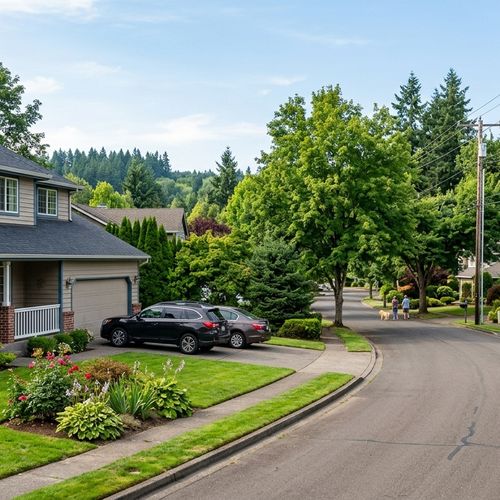



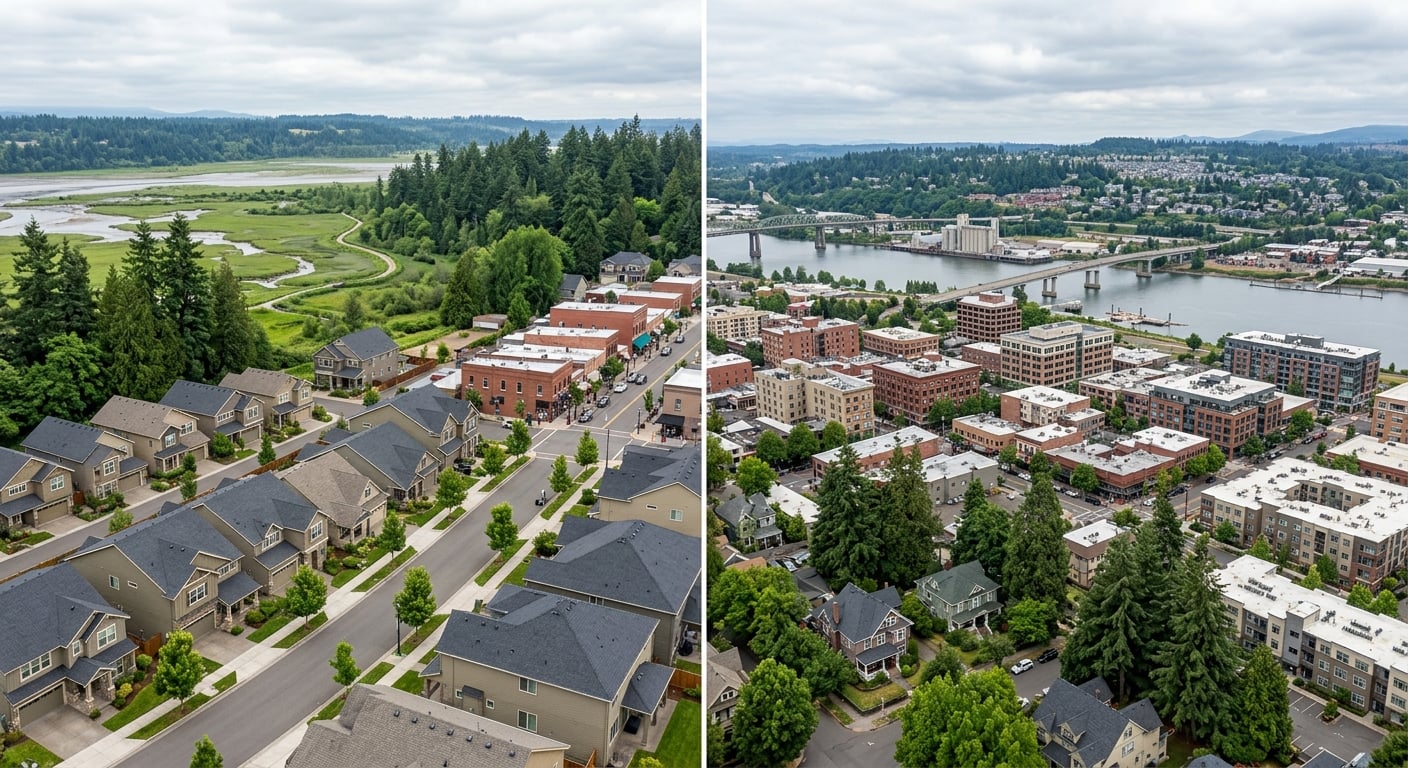
Ridgefield and Vancouver are two of the cities I work in most often, and buyers weighing one against the other ask me the same handful of questions nearly every time. Here's a direct, side-by-side look at how the two actually compare, based on what I see with real listings and real buyers.
Executive Summary
Ridgefield and Vancouver are both Clark County, Washington cities along the Columbia River, but represent very different scales: a small, fast-growing newer city compared to the county's largest city by a wide margin.
Ridgefield has grown rapidly over roughly the past 15 years, expanding out from the I-5 Exit 14 interchange through new-construction subdivisions, while keeping a small historic downtown along Pioneer Street.
Vancouver is Clark County's seat and largest city, with a downtown core built around Fort Vancouver National Historic Site and a redeveloped Columbia River waterfront.
As of mid-2026, Ridgefield's median sold price ran meaningfully higher than Vancouver's citywide median, reflecting Ridgefield's newer, more uniform housing stock against Vancouver's much larger and more varied market.
Ridgefield at a Glance
Close proximity to the Ridgefield National Wildlife Refuge, more than 5,300 acres of protected habitat along the Columbia River.
A small historic downtown along Pioneer Street (also State Route 501), with a self-guided walking tour past buildings more than a century old.
A smaller, newer city: the city's own 2025 estimate put the population at roughly 17,819, with an annual growth rate near 8.5% since 2020.
Direct access to I-5 at Exit 14, with one public school district, Ridgefield School District, serving the whole city.
Ridgefield Price Points & Amenities
Median sold price: $657,428 across 242 closed sales over the prior six months, per Resideline's market report as of August 2026.
Housing stock: predominantly newer construction, concentrated in subdivisions built out from the I-5 Exit 14 interchange over roughly the last 15 years.
Population: approximately 17,819 as of the city's 2025 estimate, with an annual growth rate near 8.5% since 2020.
Ridgefield community page: https://jamiemeushawrealestate.com/communities/ridgefield/
Read more about Ridgefield on the blog: https://jamiemeushawrealestate.com/ridgefield-small-town-charm-new-growth-and-easy-access-to-vancouver/
Watch: Living in Ridgefield, WA (YouTube playlist): https://www.youtube.com/playlist?list=PLEh0DURDVECFmf3xfz4oUxTF5TZHwSkae
Vancouver at a Glance
A downtown core built around Fort Vancouver National Historic Site: Vancouver is one of only two Pacific Northwest cities with a U.S. National Park Service historic site downtown.
A redeveloped Columbia River waterfront, including Vancouver Waterfront Park (added 2018) and the roughly five-mile Waterfront Renaissance Trail connecting Esther Short Park to Wintler Park.
By far the largest city in Clark County, with a much wider range of neighborhoods, home ages and price points than a smaller city like Ridgefield.
More than one school district depending on address: Vancouver Public Schools covers much of the city, but Evergreen Public Schools also serves parts of Vancouver.
Vancouver Price Points & Amenities
Median sold price: $500,000 over the prior six months, with the middle half of sales falling between $421,300 and $625,000, per Resideline's market report as of August 2026.
That citywide figure covers a wide range: individual Vancouver neighborhoods can run well above or below it, so it's a starting point rather than a substitute for checking a specific area.
Housing stock: broad and varied, spanning a much larger footprint and many more decades of development than Ridgefield's newer, more concentrated market.
Vancouver community page: https://jamiemeushawrealestate.com/communities/vancouver/
Check out this neighborhood in Vancouver (Lakeshore): https://jamiemeushawrealestate.com/lakeshore-vancouver-wa-northwest-clark-countys-lake-community-vancouver-lake-living-and-everything-you-need-to-know-before-you-make-the-move/
Watch: Living in Vancouver, WA (YouTube playlist): https://www.youtube.com/playlist?list=PLEh0DURDVECFMkNlNs_DxaX1z3dk2sR45
Comparing Ridgefield and Vancouver
Ridgefield and Vancouver sit along the same stretch of the Columbia River in Clark County, Washington, but represent two very different scales of city: a small, fast-growing newer community compared to the county seat and by far its largest city. Buyers who ask about both are usually weighing a compact, newer town against the variety, history and job base of a much bigger city.
Ridgefield has grown rapidly over roughly the past 15 years, expanding outward from the I-5 Exit 14 interchange through a wave of new-construction subdivisions. Its older, smaller historic downtown runs along Pioneer Street, also known as State Route 501, which the city describes as its primary corridor connecting downtown to the I-5 interchange: a self-guided walking tour there covers about 1.15 miles past buildings more than a century old. The city's own 2025 estimate put the population at roughly 17,819, with an annual growth rate near 8.5% since 2020, a pace that's drawn real local debate over keeping downtown's historic character as new subdivisions expand around it. The Ridgefield National Wildlife Refuge, more than 5,300 acres of protected wetland and upland habitat along the Columbia River, sits adjacent to the city and is one of its defining features. Ridgefield School District serves the entire city.
Vancouver is Clark County's largest city by a wide margin, with a downtown core built around Fort Vancouver National Historic Site: Vancouver is one of only two Pacific Northwest cities with a U.S. National Park Service historic site in its downtown. The Confluence Land Bridge connects the fort grounds to the Columbia River waterfront, where Vancouver Waterfront Park, a 7-acre park added in 2018, anchors a stretch of redeveloped riverfront. The Waterfront Renaissance Trail runs roughly five miles one-way, connecting downtown's Esther Short Park to Wintler Park along the river. Unlike Ridgefield's single school district, Vancouver is served by more than one: Vancouver Public Schools covers much of the city, but Evergreen Public Schools serves other Vancouver addresses, so school assignment depends on the specific property.
Price is where the two cities currently diverge. Ridgefield's median sold price was $657,428 across 242 closed sales over the prior six months, per Resideline's market report as of August 2026. Vancouver's median sold price over a comparable recent six-month period was $500,000, with the middle half of sales falling between $421,300 and $625,000, per the same Resideline source as of August 2026. Ridgefield's newer, more uniform housing stock currently carries a higher median than Vancouver's much larger and more varied market, though Vancouver's wide price range means specific neighborhoods there can run well above or below its citywide median, so it's worth checking a specific area rather than relying on the citywide figure alone.
Commute patterns differ with city size. Ridgefield connects to the rest of the metro via I-5 at Exit 14, putting it on the direct north-south corridor toward Vancouver and Portland. Vancouver sits at the center of that same corridor, served by both I-5 and I-205, with more route options into Portland but correspondingly more in-city traffic to navigate depending on the specific neighborhood. Actual drive times in both cases depend heavily on time of day and are worth testing directly during the hours a buyer would actually be commuting.
Parks and outdoor access reflect each city's scale. Ridgefield's signature outdoor feature is the Ridgefield National Wildlife Refuge itself, along with newer neighborhood parks built into its recent subdivisions. Vancouver offers the redeveloped Vancouver Waterfront Park, the Waterfront Renaissance Trail, Esther Short Park downtown, and dozens of additional parks spread across its much larger footprint: more total variety, spread over a bigger area, than a single smaller city like Ridgefield can offer.
Both cities sit within Washington, with no state income tax in either, a shared advantage that doesn't change based on which of the two a buyer chooses. Where they differ is scale and character: Ridgefield's small-town growth story against Vancouver's role as Clark County's historic, economic and population center.
Neither city is simply a smaller or larger version of the other: they offer genuinely different trade-offs. Ridgefield offers newer construction, direct interstate access, proximity to a major wildlife refuge and one school district, currently at a higher median price than Vancouver. Vancouver offers far more neighborhood variety, a historic downtown anchored by a National Park Service site, redeveloped waterfront amenities and multiple school district options, at a lower citywide median price that still varies by specific neighborhood. A side-by-side comparison of current listings in both (and in the specific Vancouver neighborhood a buyer has in mind) is the clearest way to see how these differences show up in practice.
Should You Consider Ridgefield or Vancouver?
Both Ridgefield and Vancouver are worth a direct look for anyone comparing Clark County, Washington cities. The right fit comes down to budget, how much downtown history and waterfront access matter, and whether a smaller or larger city fits a buyer's day-to-day better.
Work With Jamie
Jamie has been in real estate for 30 years and works with relocation buyers to compare cities, neighborhoods, commutes and property types until something actually fits — not to sell one particular neighborhood.
Book a Strategy Call: https://calendly.com/jamiemeushawrealestate
Call / Text: (360) 798-7127
Email: [email protected]
Website: https://www.jamiemeushawrealestate.com
Check out this article next