


Portland and Beaverton are two of the cities I work in most often, and buyers weighing one against the other ask me the same handful of questions nearly every time. Here's a direct, side-by-side look at how the two actually compare, based on what I see with real listings and real buyers.
Executive Summary
Portland and Beaverton sit on the Oregon side of the same metro area, but represent two different scales of place: Portland is the regional center itself, Beaverton one of its largest and longest-established west-side suburbs.
Portland is far larger, with dozens of distinct neighborhoods and a wide range of housing stock, price points and school districts; Beaverton is a single, more compact city built around a well-known tech-sector employment base.
Beaverton offers direct TriMet MAX light rail access into downtown Portland, a transit link that many individual Portland neighborhoods themselves don't have as directly.
As of 2026 reporting, Portland's citywide median sale price ran somewhat above Beaverton's, though both figures vary by source and move with the market.
Portland at a Glance
Dozens of distinct neighborhoods, from dense inner-eastside areas with early-1900s craftsman and foursquare homes to outer neighborhoods with newer infill and multifamily construction.
Forest Park, more than 5,100 acres and among the largest forested urban parks in the country, along with Washington Park's Japanese Garden and International Rose Test Garden.
A dense network of interstates (I-5, I-84, I-205) plus TriMet's full bus network and multiple MAX light rail lines running through the city.
Multiple school districts depending on address: Portland Public Schools covers much of the city, but David Douglas, Parkrose and other districts also serve parts of Portland.
Portland Price Points & Amenities
Median sale price: $518,000 over the three months ending September 2026, down 2.2% year over year, per Redfin's Portland housing market page.
Housing stock: broad and varied, from early-1900s craftsman and foursquare homes in inner neighborhoods to mid-century homes and newer construction throughout the rest of the city.
Portland community page: https://jamiemeushawrealestate.com/communities/portland/
Check out this neighborhood in Portland (St. Johns): https://jamiemeushawrealestate.com/st-johns-or-north-portlands-most-distinct-neighborhood-real-community-character-and-everything-you-need-to-know-before-you-make-the-move/
Watch: Living in Portland, OR (YouTube playlist): https://www.youtube.com/playlist?list=PLEh0DURDVECEbBfnaW5QcuZR0O9dXpOBB
Beaverton at a Glance
Direct TriMet MAX light rail access via the Blue and Red lines, with stops including Beaverton Transit Center, Beaverton Central and Millikan Way, plus WES Commuter Rail service south to Wilsonville.
A long-running tech-sector employment base, with the MAX line running past the Tektronix and Nike campuses on its way toward Hillsboro's Intel-area employers.
A single, more compact city than Portland, served primarily by one district, Beaverton School District.
Access via Highway 217 and US-26 (the Sunset Highway), connecting directly into central Portland and the broader west-side suburbs.
Beaverton Price Points & Amenities
Median sale price: $477,450 over the trailing six months (285 closed sales), per Resideline's Beaverton market data (ZIP 97006) as of October 5, 2026. Other recent sources have put Beaverton's median anywhere from roughly $520,000 to $630,000 depending on ZIP code and methodology.
Housing stock: a more compact mix of home ages and styles concentrated in a single, well-established suburb rather than spread across dozens of separate neighborhoods.
Beaverton community page: https://jamiemeushawrealestate.com/communities/beaverton/
Check out this neighborhood in Beaverton (Cedar Mill): https://jamiemeushawrealestate.com/cedar-mill-or-washington-countys-quiet-overachiever-beaverton-schools-and-everything-you-need-to-know-before-you-make-the-move/
Comparing Portland and Beaverton
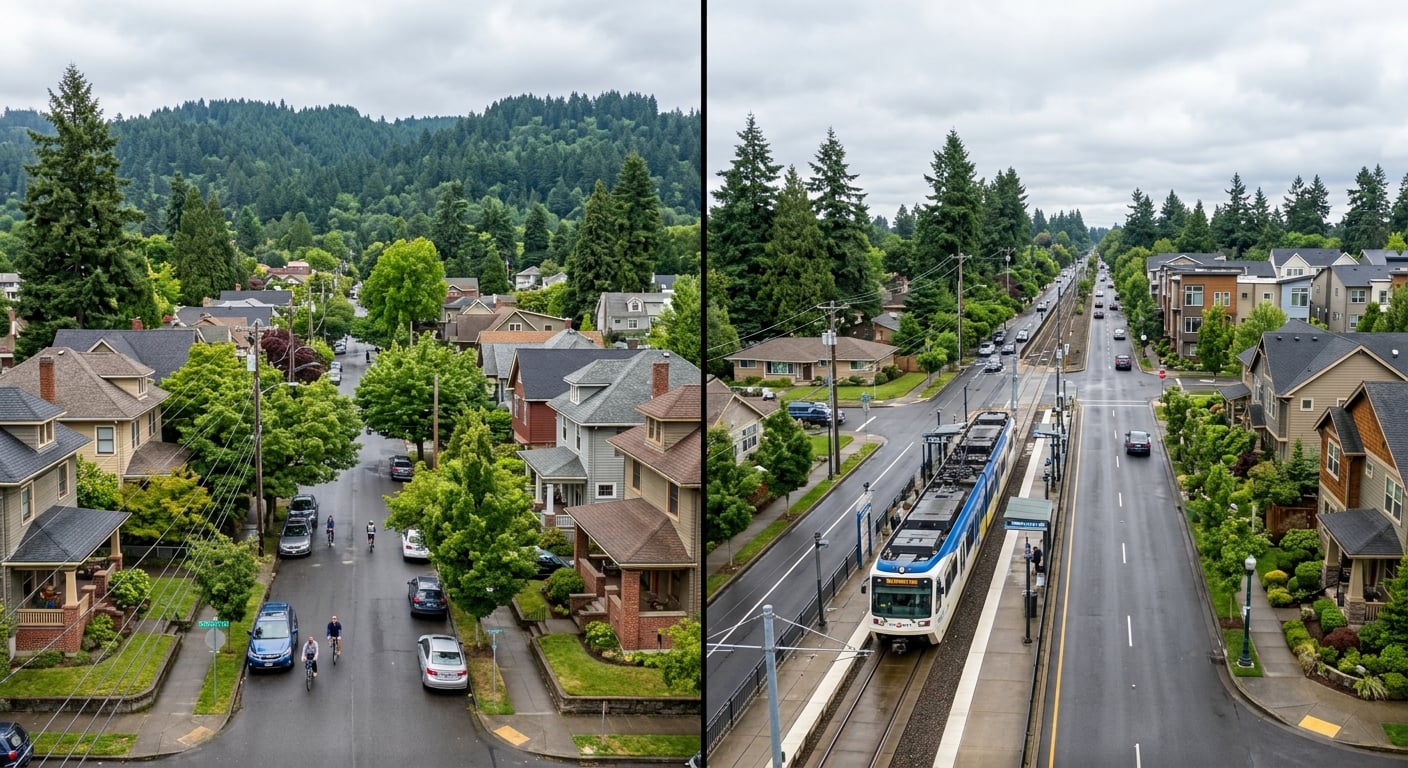
Portland and Beaverton both sit on the Oregon side of the Portland-Vancouver metro, but comparing them means comparing a major city to one of its own suburbs: Beaverton sits just west of Portland's city limits, close enough that some buyers treat the two as a single housing market even though they're separate cities with separate governments, school systems and transit profiles.
Portland is the regional center, by far the largest city in the metro, made up of dozens of distinct, differently named neighborhoods, from dense inner-eastside areas with early-1900s craftsman and foursquare homes, to outer neighborhoods with newer infill and multifamily construction. That range means housing stock, price and neighborhood character vary enormously within Portland itself, more than they do across an entire smaller city.
Beaverton is considerably more compact, a single, well-established suburb built up over decades rather than a patchwork of dozens of separate neighborhoods. Its defining feature for many buyers is transit and employment access: TriMet's MAX light rail runs directly through the city, with stops at Beaverton Transit Center, Beaverton Central and Millikan Way, and WES Commuter Rail extends service south to Wilsonville. The MAX line also runs past the Tektronix and Nike campuses on its way toward Hillsboro, where Intel has a major presence, making Beaverton a genuine option for buyers who work in the area's tech sector and want a shorter commute without living inside Portland's city limits.
Price comparisons between the two depend heavily on which data point you're looking at, since Beaverton's figures in particular have been reported inconsistently across sources recently. Portland's citywide median sale price was $518,000 over the three months ending September 2026, down 2.2% year over year, per Redfin's own Portland market page. Beaverton's most recently dated figure is $477,450 over the trailing six months (285 closed sales), per Resideline's ZIP 97006 report as of October 5, 2026, though other 2026 sources have shown Beaverton medians ranging from roughly $520,000 up to $630,000 depending on ZIP code and methodology. On the numbers available, Portland's citywide median currently runs somewhat above Beaverton's, but the spread between sources is wide enough in both cities that current listings are worth checking directly rather than relying on any single reported figure.
It's also worth remembering that Portland's citywide median in particular hides enormous neighborhood-to-neighborhood variation: some Portland neighborhoods run well above Beaverton's price level, others run well below it. A citywide number for Portland is a reasonable starting point, but it isn't a substitute for checking the specific neighborhood a buyer actually has in mind, the way a single, more compact city like Beaverton can be evaluated more directly as a whole.
Commute and transit access is where the practical difference between the two is clearest. Portland sits at the center of the region's interstate network (I-5, I-84 and I-205 all run through or around the city), and is served by TriMet's bus network along with multiple MAX light rail lines, so transit options vary by neighborhood. Beaverton's own MAX access runs directly into downtown Portland, giving many Beaverton residents a transit commute that's just as direct as living in parts of Portland itself, without the citywide price variation that comes with Portland's larger footprint.
Schools reflect the same difference in scale. Portland is served by multiple districts depending on the exact address: Portland Public Schools covers much of the city, but David Douglas, Parkrose and other districts also serve parts of Portland, and boundaries have periodically been redrawn. Beaverton is served primarily by Beaverton School District. School boundaries and assignments can change in either city, so buyers should verify current assignments directly with the relevant district rather than relying on a general reputation.
Neither city is simply a smaller or cheaper version of the other: they offer genuinely different trade-offs. Portland offers far more neighborhood variety, park acreage like Forest Park, and a wider range of housing stock and price points, with a citywide median that still varies enormously by specific neighborhood. Beaverton offers a more compact, single city with direct light rail access to Portland's tech-sector employers and a somewhat lower recent median, in a smaller overall footprint. A side-by-side look at current listings in both (and in the specific Portland neighborhood a buyer has in mind, not just the city as a whole) is the clearest way to see how these differences show up in practice.
Should You Consider Portland or Beaverton?
Portland and Beaverton serve different needs within the same metro (a major city with dozens of distinct neighborhoods versus a single, transit-connected suburb), and the right fit depends on how much neighborhood variety a buyer wants weighed against a more compact commute and tech-sector proximity.
Work With Jamie
Jamie has been in real estate for 30 years and works with relocation buyers to compare cities, neighborhoods, commutes and property types until something actually fits — not to sell one particular neighborhood.
Book a Strategy Call: https://calendly.com/jamiemeushawrealestate
Call / Text: (360) 798-7127
Email: [email protected]
Website: https://www.jamiemeushawrealestate.com
Check out this article next